 Add to Chrome
 Add to Firefox
 Add to Edge
Smaller Models are Natural Explorers for Policy-Level Diversity in GRPO
May 29, 2026
We identify a new dimension for enhancing rollout diversity in Group Relative Policy Optimization (GRPO) for LLMs. While GRPO relies on diverse rollouts, prevailing strategies primarily increase diversity by injecting more token-level randomness, which may introduce step-wise noise and lead to incoherent trajectories. We uncover that smaller models within the same model family inherently exhibit higher policy-level diversity, indicated by their superior pass@k relative to larger counterparts as sample counts increase. Unlike token-level noise, this diversity is temporally correlated, preserves logical consistency, and provides structured exploration signals for gradient estimation. We thus propose S2L-PO (Small-to-Large Policy Optimization), a framework that leverages fixed small models as natural explorers to train larger models. To balance exploration and exploitation, we design a progressive annealing strategy that transitions from offline small-model rollouts to the large learner's own sampling. This shift elegantly avoids mid-training performance drops caused by the small model's capacity limits, achieving faster convergence and unlocking a higher performance ceiling. S2L-PO improves accuracy on diverse mathematical reasoning benchmarks (e.g., +8.8% on AIME 24 using a 1.7B explorer to guide the 8B model) while reducing rollout compute.

From Procedural Skills to Strategy Genes: Towards Experience-Driven Test-Time Evolution
Apr 16, 2026This beta technical report asks how reusable experience should be represented so that it can function as effective test-time control and as a substrate for iterative evolution. We study this question in 4.590 controlled trials across 45 scientific code-solving scenarios. We find that documentation-oriented Skill packages provide unstable control: their useful signal is sparse, and expanding a compact experience object into a fuller documentation package often fails to help and can degrade the overall average. We further show that representation itself is a first-order factor. A compact Gene representation yields the strongest overall average, remains competitive under substantial structural perturbations, and outperforms matched-budget Skill fragments, while reattaching documentation-oriented material usually weakens rather than improves it. Beyond one-shot control, we show that Gene is also a better carrier for iterative experience accumulation: attached failure history is more effective in Gene than in Skill or freeform text, editable structure matters beyond content alone, and failure information is most useful when distilled into compact warnings rather than naively appended. On CritPt, gene-evolved systems improve over their paired base models from 9.1% to 18.57% and from 17.7% to 27.14%. These results suggest that the core problem in experience reuse is not how to supply more experience, but how to encode experience as a compact, control-oriented, evolution-ready object.
Sparkle: A Robust and Versatile Representation for Point Cloud based Human Motion Capture
Apr 01, 2026Point cloud-based motion capture leverages rich spatial geometry and privacy-preserving sensing, but learning robust representations from noisy, unstructured point clouds remains challenging. Existing approaches face a struggle trade-off between point-based methods (geometrically detailed but noisy) and skeleton-based ones (robust but oversimplified). We address the fundamental challenge: how to construct an effective representation for human motion capture that can balance expressiveness and robustness. In this paper, we propose Sparkle, a structured representation unifying skeletal joints and surface anchors with explicit kinematic-geometric factorization. Our framework, SparkleMotion, learns this representation through hierarchical modules embedding geometric continuity and kinematic constraints. By explicitly disentangling internal kinematic structure from external surface geometry, SparkleMotion achieves state-of-the-art performance not only in accuracy but crucially in robustness and generalization under severe domain shifts, noise, and occlusion. Extensive experiments demonstrate our superiority across diverse sensor types and challenging real-world scenarios.
Mitigating the Reasoning Tax in Vision-Language Fine-Tuning with Input-Adaptive Depth Aggregation
Mar 27, 2026Supervised fine-tuning (SFT) on visual instruction data often improves perceptual capabilities in vision-language models (VLMs) while degrading reasoning performance, creating a persistent reasoning tax during post-training. We investigate whether this degradation is related to disrupted access to depth-wise representations, and find that even fixed cross-depth aggregation substantially restores reasoning, suggesting that preserved cross-depth access is an important missing factor in VLM fine-tuning. Building on this observation, we propose Input-Adaptive Depth Aggregation (IADA), a lightweight mechanism that makes cross-depth retrieval input-adaptive, modality-aware, and efficiently parameterized through a low-rank bottleneck. On Qwen3-VL-2B, IADA improves the average reasoning score by 9.5 points and the average perception score by $3.3$ points over LoRA-only fine-tuning with only 0.14M additional parameters, with the strongest gains appearing in parameter-efficient low-rank settings.
UniBioTransfer: A Unified Framework for Multiple Biometrics Transfer
Mar 20, 2026Deepface generation has traditionally followed a task-driven paradigm, where distinct tasks (e.g., face transfer and hair transfer) are addressed by task-specific models. Nevertheless, this single-task setting severely limits model generalization and scalability. A unified model capable of solving multiple deepface generation tasks in a single pass represents a promising and practical direction, yet remains challenging due to data scarcity and cross-task conflicts arising from heterogeneous attribute transformations. To this end, we propose UniBioTransfer, the first unified framework capable of handling both conventional deepface tasks (e.g., face transfer and face reenactment) and shape-varying transformations (e.g., hair transfer and head transfer). Besides, UniBioTransfer naturally generalizes to unseen tasks, like lip, eye, and glasses transfer, with minimal fine-tuning. Generally, UniBioTransfer addresses data insufficiency in multi-task generation through a unified data construction strategy, including a swapping-based corruption mechanism designed for spatially dynamic attributes like hair. It further mitigates cross-task interference via an innovative BioMoE, a mixture-of-experts based model coupled with a novel two-stage training strategy that effectively disentangles task-specific knowledge. Extensive experiments demonstrate the effectiveness, generalization, and scalability of UniBioTransfer, outperforming both existing unified models and task-specific methods across a wide range of deepface generation tasks. Project page is at https://scy639.github.io/UniBioTransfer.github.io/
Persistent Sheaf Laplacian Analysis of Protein Stability and Solubility Changes upon Mutation
Jan 18, 2026Genetic mutations frequently disrupt protein structure, stability, and solubility, acting as primary drivers for a wide spectrum of diseases. Despite the critical importance of these molecular alterations, existing computational models often lack interpretability, and fail to integrate essential physicochemical interaction. To overcome these limitations, we propose SheafLapNet, a unified predictive framework grounded in the mathematical theory of Topological Deep Learning (TDL) and Persistent Sheaf Laplacian (PSL). Unlike standard Topological Data Analysis (TDA) tools such as persistent homology, which are often insensitive to heterogeneous information, PSL explicitly encodes specific physical and chemical information such as partial charges directly into the topological analysis. SheafLapNet synergizes these sheaf-theoretic invariants with advanced protein transformer features and auxiliary physical descriptors to capture intrinsic molecular interactions in a multiscale and mechanistic manner. To validate our framework, we employ rigorous benchmarks for both regression and classification tasks. For stability prediction, we utilize the comprehensive S2648 and S350 datasets. For solubility prediction, we employ the PON-Sol2 dataset, which provides annotations for increased, decreased, or neutral solubility changes. By integrating these multi-perspective features, SheafLapNet achieves state-of-the-art performance across these diverse benchmarks, demonstrating that sheaf-theoretic modeling significantly enhances both interpretability and generalizability in predicting mutation-induced structural and functional changes.
SIN-Bench: Tracing Native Evidence Chains in Long-Context Multimodal Scientific Interleaved Literature
Jan 15, 2026Evaluating whether multimodal large language models truly understand long-form scientific papers remains challenging: answer-only metrics and synthetic "Needle-In-A-Haystack" tests often reward answer matching without requiring a causal, evidence-linked reasoning trace in the document. We propose the "Fish-in-the-Ocean" (FITO) paradigm, which requires models to construct explicit cross-modal evidence chains within native scientific documents. To operationalize FITO, we build SIN-Data, a scientific interleaved corpus that preserves the native interleaving of text and figures. On top of it, we construct SIN-Bench with four progressive tasks covering evidence discovery (SIN-Find), hypothesis verification (SIN-Verify), grounded QA (SIN-QA), and evidence-anchored synthesis (SIN-Summary). We further introduce "No Evidence, No Score", scoring predictions when grounded to verifiable anchors and diagnosing evidence quality via matching, relevance, and logic. Experiments on eight MLLMs show that grounding is the primary bottleneck: Gemini-3-pro achieves the best average overall score (0.573), while GPT-5 attains the highest SIN-QA answer accuracy (0.767) but underperforms on evidence-aligned overall scores, exposing a gap between correctness and traceable support.
SymbioSim: Human-in-the-loop Simulation Platform for Bidirectional Continuing Learning in Human-Robot Interaction
Feb 11, 2025The development of intelligent robots seeks to seamlessly integrate them into the human world, providing assistance and companionship in daily life and work, with the ultimate goal of achieving human-robot symbiosis. To realize this vision, robots must continuously learn and evolve through consistent interaction and collaboration with humans, while humans need to gradually develop an understanding of and trust in robots through shared experiences. However, training and testing algorithms directly on physical robots involve substantial costs and safety risks. Moreover, current robotic simulators fail to support real human participation, limiting their ability to provide authentic interaction experiences and gather valuable human feedback. In this paper, we introduce SymbioSim, a novel human-in-the-loop robotic simulation platform designed to enable the safe and efficient development, evaluation, and optimization of human-robot interactions. By leveraging a carefully designed system architecture and modules, SymbioSim delivers a natural and realistic interaction experience, facilitating bidirectional continuous learning and adaptation for both humans and robots. Extensive experiments and user studies demonstrate the platform's promising performance and highlight its potential to significantly advance research on human-robot symbiosis.
NPC: Neural Predictive Control for Fuel-Efficient Autonomous Trucks
Dec 18, 2024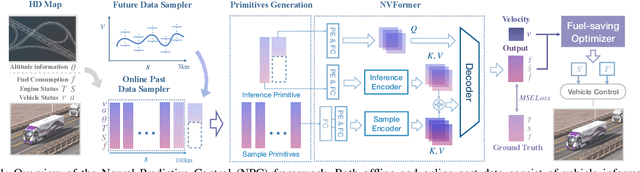
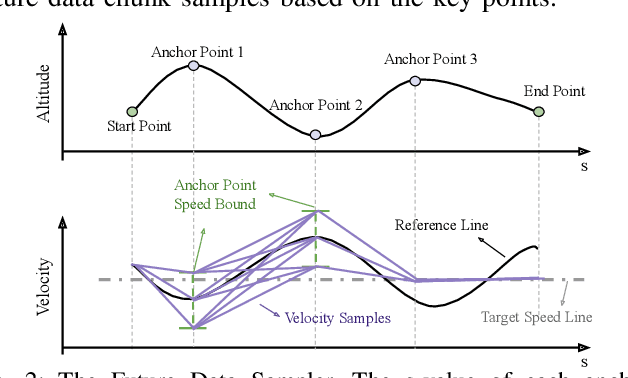
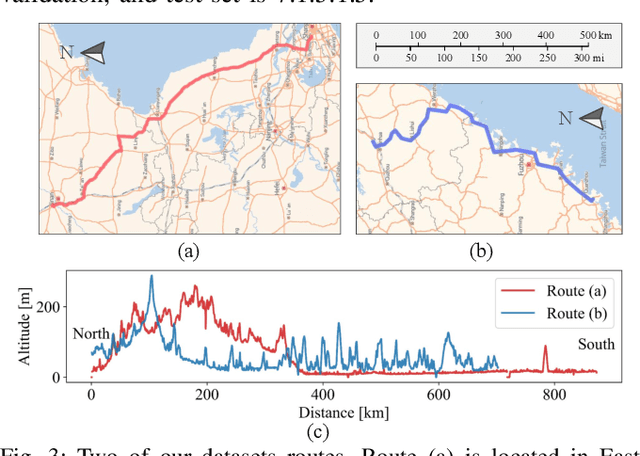
Fuel efficiency is a crucial aspect of long-distance cargo transportation by oil-powered trucks that economize on costs and decrease carbon emissions. Current predictive control methods depend on an accurate model of vehicle dynamics and engine, including weight, drag coefficient, and the Brake-specific Fuel Consumption (BSFC) map of the engine. We propose a pure data-driven method, Neural Predictive Control (NPC), which does not use any physical model for the vehicle. After training with over 20,000 km of historical data, the novel proposed NVFormer implicitly models the relationship between vehicle dynamics, road slope, fuel consumption, and control commands using the attention mechanism. Based on the online sampled primitives from the past of the current freight trip and anchor-based future data synthesis, the NVFormer can infer optimal control command for reasonable fuel consumption. The physical model-free NPC outperforms the base PCC method with 2.41% and 3.45% more significant fuel saving in simulation and open-road highway testing, respectively.
* 7 pages, 6 figures, for associated mpeg file, see https://www.youtube.com/watch?v=hqgpj7LhiL4
FreeCap: Hybrid Calibration-Free Motion Capture in Open Environments
Nov 07, 2024


We propose a novel hybrid calibration-free method FreeCap to accurately capture global multi-person motions in open environments. Our system combines a single LiDAR with expandable moving cameras, allowing for flexible and precise motion estimation in a unified world coordinate. In particular, We introduce a local-to-global pose-aware cross-sensor human-matching module that predicts the alignment among each sensor, even in the absence of calibration. Additionally, our coarse-to-fine sensor-expandable pose optimizer further optimizes the 3D human key points and the alignments, it is also capable of incorporating additional cameras to enhance accuracy. Extensive experiments on Human-M3 and FreeMotion datasets demonstrate that our method significantly outperforms state-of-the-art single-modal methods, offering an expandable and efficient solution for multi-person motion capture across various applications.